
Deal Shield
The only buy-to-let appraisal that runs on the listing page itself.
Other tools can run these numbers. You have to go to them, type in an address and an asking price, and do it again for the next one. Deal Shield is already on the page, already filled in, and has an answer before you have typed anything.

It has an answer before you type anything
Every other appraisal tool starts with a blank form. You go to it, enter an address, an asking price and a rent you have guessed, and only then does it tell you anything. Do that thirty times in an evening and you stop doing it, which is why most investors dismiss most properties on instinct.
Deal Shield opens with the appraisal already done. It reads the price, the bedrooms, the property type and the location off the page, and starts the rent from official ONS figures for that local authority - not the headline average, but the figure for that bedroom count and that property type, adjusted for how the asking price compares with the area. Then it says plainly that the figure is an anchor rather than a comparable, and asks you to confirm it.
“What rent would this need?”
When a property misses your target, Deal Shield tells you the rent it would have to achieve to clear it, and how far that is above the local anchor. “Needs £2,730 a month, 16% above the area” is a question you can actually answer by looking at two rental listings. A yield percentage is not.
It refuses to be confidently wrong
Where the anchor implies a yield nobody should trust, it withholds the verdict and the offer price rather than dressing up a guess. We do not model rents or scrape comparables. The appraisal says “rent set by you, against the ONS local figure”, which is a sentence that survives a conversation with a lender.
The number that decides whether a cheap property is actually cheap
A listing shows you the EPC band and nothing else. It does not tell you what that band costs to fix. With a minimum of C proposed for rented homes, the gap between a D and a C is real money, and it lands on the buyer.
Deal Shield finds the property's actual certificate on the open EPC register, reads the measures the assessor recommended, and puts a cost range on getting it to a C. That figure sits in the appraisal alongside everything else, so the deal you are looking at is the deal including the works, rather than the deal before you found out.
Estimates based on the register's own recommended measures. Indicative, not a quote, and not a substitute for a survey.
On every listing you open
Judged against your rule, not a generic one
Set the yield or cashflow you buy at once, and every listing tells you whether it clears it. Buying below market value instead? Enter the end value after refurbishment and it works out your offer at 20, 25, 30, 35 and 40% BMV, and which of your saved clients that suits.
The numbers, filled in
Net monthly cashflow, net and gross yield, and the maximum sensible bid worked out from the cash you actually have. Or leave the cash box empty and it answers the other way round: what this deal needs, in one line, after deposit, stamp duty, legals and works.
Company or personal
One switch changes the whole appraisal, including Section 24 treatment and corporation tax, so you can see which route the deal survives. Override the purchase tax with your own figure and every number on the card follows it.
Lender stress test
Whether it passes ICR at a stressed rate, the loan that would clear, and where your breakeven sits if rates move against you.
Sold prices and area
Local price growth over five years and over the last twelve months, because they routinely disagree. Article 4 directions, planning applications nearby, and comparable sales worked through properly - see below.
Watchlist
Track the ones you are chasing. Deal Shield re-checks the asking price once a day and tells you when one is reduced or comes back on.
Show the workings
Every figure opens up. See the actual arithmetic behind the stamp duty, the interest, the cashflow and the loan the rent supports, with the rules version it used. One button copies the whole appraisal as text, for a deal pack, an email or an AI assistant.
Your figures stay yours
Your cash position, rates and assumptions are stored in your browser. They are never sent to us and never sold to anyone.
If you source for clients
Sourcing is not really an appraisal problem. It is a problem of screening forty listings against several different briefs, and then being able to show a client why three of them made the shortlist.
Every client's brief at once
Save a profile per client with their pot, their structure and their target. Each listing then tells you who it suits, without switching profile five times a property. A limited-company buyer and a cash buyer are different deals on the same house, and it prices both.
A report that shows the work
One page for the client: the brief, what met it, and what was considered and rejected with the reason for each. Your logo and business name on it. Every other tool hands over the shortlist; none of them evidences the thirty-seven properties you ruled out, which is the part you were paid for.
Offers worked back from the end value
Enter what the property will be worth once refurbished and it works out your offer at 20, 25, 30, 35 and 40% below market value, measured after deducting your works budget, and tells you the discount the asking price already achieves. Save a BMV rule per client and a listing tells you whose it clears. Deal Shield does not guess the end value. You set it, from the comparables it puts in front of you.
Straight into your deal pack
One button copies the whole appraisal as plain text, ready to paste into a deal pack, an email or an AI assistant. It writes the cost assumptions out in full rather than burying them, so management and void allowances cannot quietly fall out between your figures and the document your investor reads.
Comparables you would actually use
A list of every sale on the street for the last decade is not a set of comparables. It is a list. What matters is whether a sale was the same kind of property, how big it was, how close it was, and how long ago.
Deal Shield pulls registered sales within about a quarter of a mile and shows each one with its property type, its floor area and its distance, grouped into this postcode and nearby, filterable to the last twelve months, with same-type sales marked. The price per square foot is worked out within property type where the sample allows it, because a flat and a detached house on the same street do not trade at the same rate. And it always shows which years the sales came from, since those prices are historic and a median built from 2015 flatters a price asked today.
The same instinct runs through the rest of it. On a Scottish or Welsh property it names LBTT or LTT, declines to show you an English stamp duty figure as though it applied, and lets you enter the real one so every number follows yours. A tool that is confidently wrong about tax is worse than no tool.
Sold prices from HM Land Registry under the Open Government Licence, matched to floor areas on the open EPC register. Coverage is not complete and the last two months of sales are usually still being registered.
The appraisal sits beside the listing
It opens on the property page itself. Set your cash pot once and it carries across every property you look at.

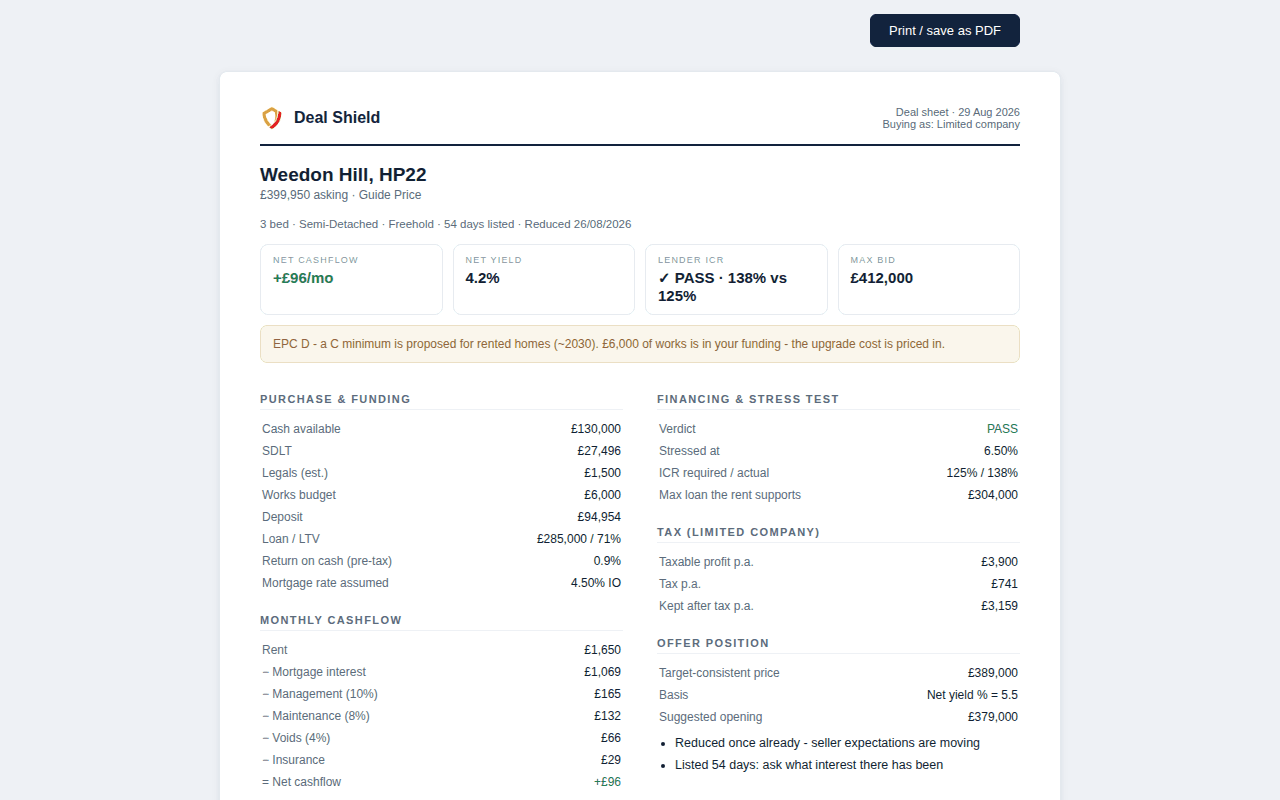
And exports as a deal sheet
A print-ready appraisal to send to a broker, a partner, or a client, with the assumptions it was built on shown at the bottom.
What it costs
Nothing. Deal Shield is free in full, on the Chrome Web Store, while we build it out. If paid plans come later, anyone using it before then keeps what they have.
It covers England and Northern Ireland for stamp duty. Wales and Scotland use different systems and are not modelled yet. It is information to help you appraise a purchase, not financial advice, and the figures are only as good as the assumptions you give it.
What it does with your data
Your deal figures never leave your browser. The extension asks open data services about a property's postcode; it does not tell them who is asking. There is no analytics in the extension, no cookies, and no profile of you. The Deal Shield privacy notice sets out exactly what leaves the browser and why.